+86 153 7870 3202
+86 153 7870 3202
As a benchmark of German high-performance sports cars, the Porsche 911 Carrera excels in power output and agile handling for extreme road and track driving. Conventional cast-iron brake systems struggle to withstand intensive, frequent braking loads generated by high-speed driving and aggressive acceleration and deceleration. As a revolutionary upgrade, carbon ceramic brake discs perfectly align with the 911’s extreme performance positioning. Boasting ultra-light weight, superior thermal stability and outstanding durability, this advanced braking technology resolves traditional brake pain points including thermal recession, excessive unsprung mass and short service life. It significantly boosts the vehicle’s braking efficiency, handling precision and driving safety, serving as a core configuration to unlock the full performance potential of the Porsche 911.
Lightweight Structural Optimization Enhancing Porsche 911 Dynamic Response
Extreme Thermal Stability Eliminating High Load Braking Recession
Long Durability and Low Maintenance Adapting to High Frequency Performance Driving
Unsprung mass is critical to a vehicle’s handling and suspension responsiveness, and heavy cast-iron brake discs severely limit the dynamic performance of sports cars. The Porsche 911’s carbon ceramic brake discs adopt carbon fiber reinforced ceramic composites, cutting nearly 50% of weight compared with standard cast-iron discs. A full set of four discs reduces unsprung mass by 15 to 20 kg, optimizing the vehicle’s mass distribution. This lightweight advantage is particularly prominent for the 911’s rear-engine layout. Lighter unsprung mass allows the suspension to better adapt to road surfaces, suppress high-speed and cornering body jitter, and sharpen steering sensitivity. Meanwhile, reduced brake disc rotational inertia optimizes acceleration and deceleration linearity, delivering precise, responsive braking and pure driving feedback.
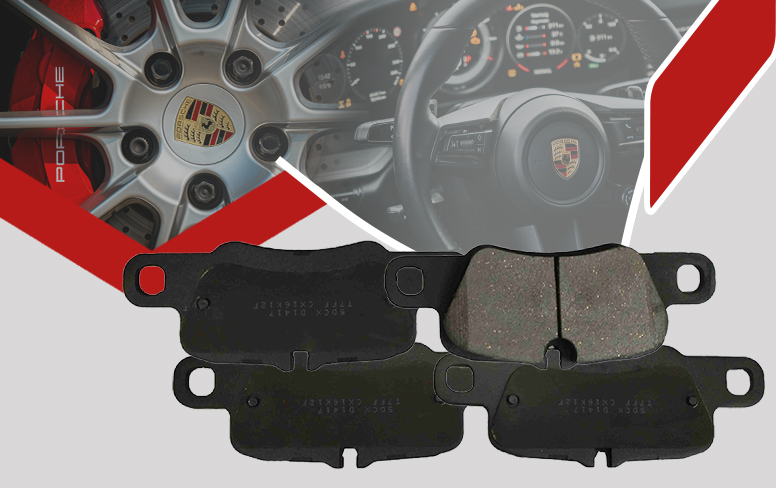
Intense track driving and high-speed cruising subject brakes to extreme temperatures, causing thermal recession, deformation and even failure in conventional cast-iron systems, which poses major safety risks. The Porsche 911’s customized carbon ceramic brake system features exceptional high-temperature resistance and thermal stability, tolerating far higher temperatures than traditional brakes. Its composite structure avoids thermal expansion, deformation and friction coefficient decline during continuous heavy braking. In repeated high-speed braking scenarios, the system maintains stable friction and consistent braking force, shortens braking distances, and eliminates soft brake pedals and power attenuation caused by heat. It delivers reliable, zero-decay braking performance in both daily commuting and professional track racing across all speed ranges.
RECENT NEWS
Global Adaptability and Vehicular Compatibility of Ceramic Brake Pads
Aug. 25, 2026
Sencheer Launches New Ceramic Brake Pads in August
Aug. 11, 2026
Subtle Chassis Refinement of Ceramic Brake Pads for BMW
Aug. 04, 2026
Custom Service
For the past 15 years, Sencheer is supplying the global market with custom brake pads using OE technology. Our customization range is wide and free, which covers logo, label, brand box, carton design, spraying code etc.
Contact Number
+86 153 7870 3202
Navigation
+86 153 7870 3202
Songjia Town Development Zone, Lingcheng District, Dezhou City, Shandong, China