+86 153 7870 3202
+86 153 7870 3202
Nissan has long engineered passenger sedans, compact SUVs, pickup trucks and performance vehicles to balance daily commuting comfort, urban maneuverability and long-distance driving reliability. The factory-matched braking system serves as a core safety component that defines driving control experience. Among mainstream brake pad alternatives on the aftermarket, ceramic brake pads stand out as the most optimized upgrade solution tailored for Nissan’s original chassis calibration. Different from traditional semi-metallic and low-metallic brake pads, premium ceramic brake pads adopt copper-free ceramic composite formula, perfectly matching the factory brake rotor tolerance and pedal feedback design of Altima, Rogue, Qashqai, Frontier and full Nissan lineups, bringing all-round upgrades in safety, comfort and long-term usability for Nissan vehicle owners.
Customized Friction Performance Matching Nissan Original Chassis Tuning
Low Wear Low Noise Design Optimizing Nissan In Cabin Ride Comfort
Extended Service Cycle Cutting Long Term Maintenance Cost for Nissan Owners
Every Nissan model is calibrated with exclusive brake pedal travel, braking response threshold and rotor load parameters during manufacturing. Conventional metal brake pads feature rigid friction output, which fails to fit Nissan’s original soft-responsive braking logic and easily causes abrupt braking, jitter and unstable friction coefficient under frequent urban stop-and-go scenarios. Professional ceramic brake pads adopt micro-adjusted ceramic friction materials with stable friction value across cold and high-temperature working conditions. They deliver linear, progressive braking force consistent with Nissan factory braking tuning, enabling precise pedal control for daily urban driving, highway cruising and suburban downhill driving. Under high-temperature braking generated by continuous traffic congestion or mountain road driving, ceramic compounds effectively resist brake fade, maintaining steady stopping power without braking attenuation. For Nissan performance models and heavy-load Frontier pickups, upgraded ceramic brake pads also disperse braking heat evenly to avoid local rotor abrasion, maximizing the original braking design potential of Nissan vehicles without modifying factory brake structures.
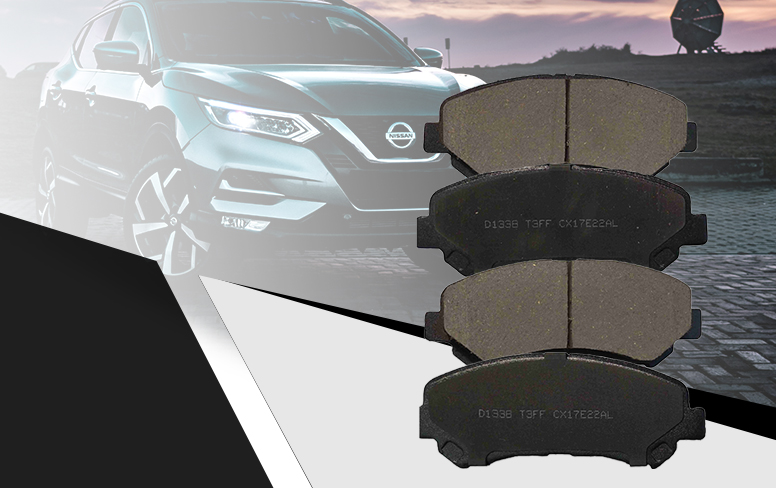
Modern Nissan vehicles prioritize refined cabin NVH performance, covering engine noise, tire wind noise and chassis vibration isolation, while braking noise is a commonly overlooked factor affecting riding quality. Semi-metallic brake pads generate harsh squealing, grinding vibration and metal friction noise during low-speed braking, which penetrates Nissan’s soundproof cotton and door sealing structure and disturbs daily riding tranquility. Built with high-density ceramic fiber bonding structure, ceramic brake pads eliminate metal-to-rotor hard friction fundamentally. Test data shows they cut braking noise by over 35% compared with original semi-metallic pads, realizing near-silent braking during parking, slow deceleration and traffic lane changing. Besides noise reduction, ceramic pads feature mild contact hardness that causes minimal wear on Nissan original brake rotors. They extend rotor service life by nearly double, meanwhile producing fine light-colored non-corrosive brake dust. Unlike stubborn black metallic dust that erodes Nissan alloy wheels, ceramic dust is easy to clean, keeping original wheel paint intact and reducing regular vehicle beauty maintenance workload for Nissan car owners.
Vehicle maintenance expenditure including brake replacement, rotor polishing and wheel cleaning occupies a regular part of Nissan user car-use cost. Traditional semi-metallic brake pads have fast abrasion consumption, requiring replacement every 30,000 to 45,000 kilometers, paired with frequent rotor maintenance due to uneven metal friction scratches. Premium ceramic brake pads own outstanding abrasion resistance adapted to global road conditions. For mainstream Nissan family models, front ceramic brake pads support 65,000 to 80,000 kilometers normal driving use, and rear pads reach more than 100,000 kilometers service mileage. The asbestos-free eco-friendly ceramic formula boasts stable chemical properties, resisting rainwater corrosion, high-temperature oxidation and road salt erosion in wet weather, which avoids pad aging, cracking and performance degradation. Though ceramic brake pads have slightly higher upfront purchasing cost, they reduce frequency of pad replacement, rotor repair and wheel deep cleaning throughout the vehicle service life. It is the most cost-effective braking upgrade choice for private Nissan commuter cars, family SUVs and daily-use pickup fleets, realizing safer, quieter and more economical full-cycle driving experience.
RECENT NEWS
Ceramic Brake Pads Elevating SAAB Driving Prowess
Jun. 30, 2026
The Hidden Advantages of Ceramic Brake Pad Technology
Jun. 16, 2026
Sencheer Launches New Ceramic Brake Pads in May
Jun. 05, 2026
Custom Service
For the past 15 years, Sencheer is supplying the global market with custom brake pads using OE technology. Our customization range is wide and free, which covers logo, label, brand box, carton design, spraying code etc.
Contact Number
+86 153 7870 3202
Navigation
+86 153 7870 3202
Songjia Town Development Zone, Lingcheng District, Dezhou City, Shandong, China