+86 153 7870 3202
+86 153 7870 3202
Thermal fade is a critical flaw limiting the high-intensity and long-duration operation of conventional automotive braking systems. Traditional semi-metallic and organic brake pads suffer severe friction coefficient decline, thermal deformation and structural damage under sustained high-temperature loads, compromising braking safety. As advanced composite components, carbon-fiber-reinforced silicon carbide (C/C-SiC) ceramic brake pads deliver exceptional thermal stability in extreme heat. This article focuses on their microscopic thermal response mechanisms, analyzes their thermal fade resistance under high thermal loads, and highlights their technical superiority over traditional pads for extreme and high-end vehicle applications.
Microscopic Structural Anti Fade Mechanism of Ceramic Composite Materials
Quantitative Analysis of Thermal Fade Stability Under Continuous Braking Conditions
Thermal Shock Resistance and Long Term Service Life Advantages
Conventional semi-metallic pads undergo matrix softening, fiber oxidation and surface carbonization at high temperatures, causing drastic friction loss. In contrast, ceramic composites resist thermal creep and structural relaxation under extreme heat. The silicon carbide matrix firmly locks the fiber framework, preventing surface smoothing and friction interface degradation. Test data verify that ceramic pads achieve a high-temperature structural deformation rate below 3%, far outperforming the 18% rate of traditional metal pads.
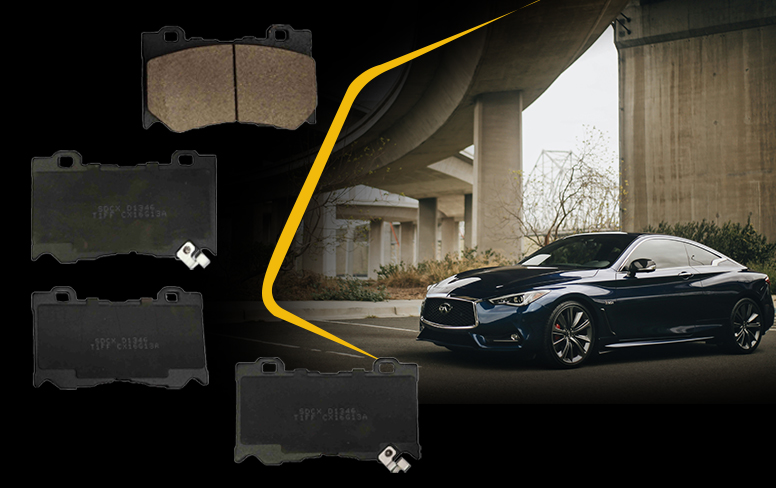
Within 200℃ to 600℃, the friction coefficient of ceramic pads fluctuates only ±0.05, compared with ±0.15 for semi-metallic pads. At temperatures above 450℃, traditional pads lose most braking power, with their friction coefficient dropping from 0.4 to below 0.2. Conversely, ceramic pads retain a coefficient above 0.38 at 600℃, with a thermal fade rate under 5%. In simulated mountain road continuous braking tests, ceramic pads show a braking distance deviation of less than 4% after 20 emergency stops, while traditional pads exceed 50% deviation.
The internal carbon fiber framework disperses instantaneous thermal stress, eliminating surface cracks and interface peeling to stabilize the friction layer long-term. Unlike traditional pads that wear rapidly after high-temperature exposure, ceramic pads resist accelerated wear under repeated thermal cycles. In high-intensity service, their lifespan is 3 to 5 times that of metal pads, reducing maintenance frequency and improving overall braking system reliability.
RECENT NEWS
Sencheer Launches New Ceramic Brake Pads in July
Jul. 20, 2026
Ceramic Brake Technology Elevating Jaguar Driving Excellence
Jul. 15, 2026
Ceramic Brake Pads Elevating SAAB Driving Prowess
Jun. 30, 2026
Custom Service
For the past 15 years, Sencheer is supplying the global market with custom brake pads using OE technology. Our customization range is wide and free, which covers logo, label, brand box, carton design, spraying code etc.
Contact Number
+86 153 7870 3202
Navigation
+86 153 7870 3202
Songjia Town Development Zone, Lingcheng District, Dezhou City, Shandong, China