+86 153 7870 3202

sales@sencheerbrake.com

News

Ceramic Brake Pads: The Fusion of Material Science and Driving Safety

In the realm of automotive safety, brake systems stand as the ultimate line of defense, and brake pads—often overlooked yet critical—determine the efficiency, comfort, and longevity of braking performance. Among the diverse range of brake pad materials, ceramic brake pads have emerged as a premium choice, blending advanced material engineering with practical driving needs. Unlike traditional metallic or organic alternatives, ceramic brake pads leverage the unique properties of ceramic composites to address common pain points such as noise, dust accumulation, and performance degradation under extreme conditions. This article delves into the core characteristics, working mechanisms, and practical advantages of ceramic brake pads, unraveling the science behind their growing popularity in modern automotive applications.

Table of contents:

The Composition: Beyond Ordinary Ceramic—A High-Performance Composite

The Working Mechanism: How Ceramic Pads Deliver Stable Braking

Core Advantages: Redefining Braking Comfort and Durability

Considerations: When Ceramic Pads May Not Be the Best Choice

Conclusion: The Ideal Choice for Modern Daily Driving


The Composition: Beyond Ordinary Ceramic—A High-Performance Composite

Ceramic brake pads are not made of the same ceramic material used in household tableware; instead, they are a sophisticated blend of high-temperature-resistant ceramic fibers, non-ferrous fillers, advanced binders, and a small amount of copper or carbon fibers for enhanced performance. Developed initially by Japanese brake manufacturers in the 1990s, this composite formulation was engineered to overcome the limitations of traditional brake pads.

The key components work in synergy: ceramic fibers (typically alumina or silica-based) provide exceptional heat resistance and wear resistance; non-ferrous fillers prevent metal-to-metal contact, reducing noise and rotor damage; binders ensure the composite maintains structural integrity even at extreme temperatures; and copper fibers improve heat conduction, preventing overheating during prolonged braking. Unlike metallic brake pads, which rely on metal particles for friction, ceramic pads minimize metal content, eliminating the harsh squeals and excessive dust associated with metal-on-metal friction.
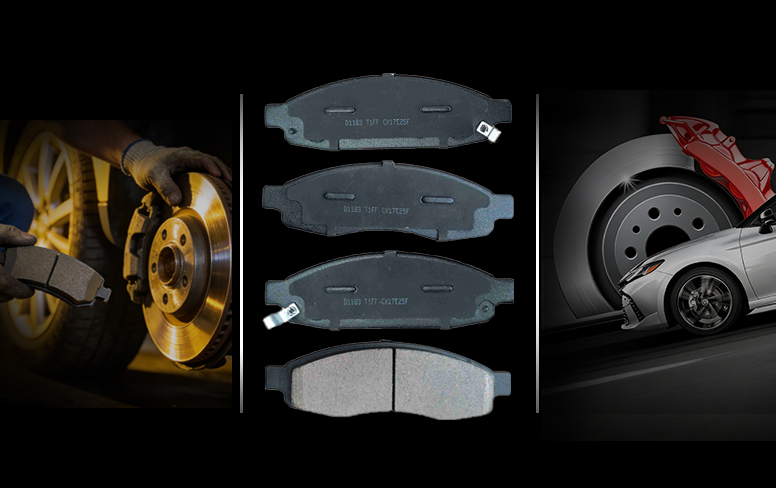
Ceramic Brake Pads: The Fusion of Material Science and Driving Safety


The Working Mechanism: How Ceramic Pads Deliver Stable Braking

The braking process relies on converting a vehicle’s kinetic energy into thermal energy through friction, and ceramic brake pads excel in this process due to their unique material properties. When the brake pedal is pressed, hydraulic fluid transmits force to the calipers, which clamp the ceramic pads against the rotating brake rotor. This contact generates friction, slowing the rotor—and thus the vehicle—while dissipating the resulting heat efficiently.

A defining advantage of ceramic brake pads is their stable friction coefficient across a wide temperature range. Unlike ordinary brake pads, whose friction coefficient drops significantly when temperatures exceed 400℃ (a phenomenon called thermal fade), ceramic pads maintain a consistent friction coefficient of 0.45-0.55 even when temperatures reach 650℃, ensuring reliable braking performance in both daily commutes and emergency situations. Additionally, the low thermal conductivity of ceramic materials reduces heat transfer to the brake system’s other components, extending the lifespan of rotors and calipers.


Core Advantages: Redefining Braking Comfort and Durability

Ceramic brake pads have gained widespread acceptance in the automotive market—particularly in Japan, North America, and increasingly in Europe—due to their multiple performance advantages that address the most common complaints about traditional brake pads.

1. Quiet Operation: Eliminating Annoying Braking Noise

Noise is a persistent issue with metallic brake pads, as metal particles rubbing against the rotor produce high-frequency squeals or grinding sounds. Ceramic brake pads, however, absorb vibrations and avoid metal-to-metal contact, significantly reducing noise levels.Measured data shows that ceramic pads reduce braking noise by approximately 60% compared to semi-metallic pads, keeping the cabin quiet even during low-speed braking or in heavy traffic. This quiet performance is achieved through both the material composition and specialized manufacturing techniques, such as slotting and chamfering, which reduce vibration and uneven contact.

2. Low Dust Emission: Keeping Wheels Clean and Aesthetic

One of the most visible benefits of ceramic brake pads is their minimal dust production. Traditional metallic pads shed black metal dust that adheres to wheels, requiring frequent cleaning to maintain a vehicle’s appearance. Ceramic pads, by contrast, produce very little dust—what little dust is generated is non-adhesive and easily washed away by rain or airflow, keeping wheels clean for longer periods. This not only enhances the vehicle’s aesthetic appeal but also reduces maintenance efforts for car owners.

3. Long Lifespan: Cost-Effective in the Long Run

Ceramic brake pads are significantly more durable than traditional organic or metallic pads. While ordinary brake pads typically last 40,000 to 60,000 kilometers, ceramic pads can reach 80,000 to 100,000 kilometers—an increase of 30% to 50% in lifespan. Their durability stems from the wear-resistant ceramic fibers, which reduce material loss during braking. Additionally, ceramic pads are gentler on brake rotors, extending the rotor’s lifespan by up to 20% and further reducing long-term maintenance costs.

4. Stable Performance: Reliable in All Driving Conditions

Ceramic brake pads perform consistently in diverse environments, from cold winters to hot summers, and in both city commutes and highway driving. Their low thermal fade ensures reliable braking even during prolonged or emergency braking, while their ability to maintain performance at temperatures up to 1000℃ makes them suitable for high-performance vehicles and challenging driving conditions. Even in low-temperature environments, ceramic pads maintain adequate friction after a few stops, ensuring no compromise in safety.


Considerations: When Ceramic Pads May Not Be the Best Choice

While ceramic brake pads offer numerous advantages, they are not a one-size-fits-all solution. Their high-performance formulation comes with a higher upfront cost compared to organic or entry-level metallic pads, which may not be cost-effective for vehicles that are rarely driven or nearing the end of their service life. Additionally, ceramic pads are less suitable for extreme performance scenarios, such as high-speed track driving or heavy towing, as they may experience faster wear and reduced grip under prolonged extreme heat. In such cases, semi-metallic or carbon-ceramic pads are more appropriate.


Conclusion: The Ideal Choice for Modern Daily Driving

Ceramic brake pads represent a perfect balance of material science and practical driving needs, addressing the key pain points of traditional brake pads—noise, dust, and inconsistent performance. Their unique composite formulation delivers quiet, clean, and durable braking, making them an ideal choice for most daily drivers, especially those who prioritize comfort, low maintenance, and safety. While they may not be suitable for extreme performance or budget-conscious users, their long-term cost-effectiveness and reliable performance have made them a staple in modern automotive design.
As automotive technology advances, ceramic brake pad formulations continue to evolve, with manufacturers incorporating nanotechnology and advanced additives to further enhance performance. For the average driver, choosing ceramic brake pads is not just an upgrade—it is an investment in safer, more comfortable, and more convenient driving.


Custom Service

For the past 15 years, Sencheer is supplying the global market with custom brake pads using OE technology. Our customization range is wide and free, which covers logo, label, brand box, carton design, spraying code etc.

Contact Number

+86 153 7870 3202

Contact Us

+86 153 7870 3202

sales@sencheerbrake.com

+86 153 7870 3202

Songjia Town Development Zone, Lingcheng District, Dezhou City, Shandong, China

Subscribe Newsletter