+86 153 7870 3202
+86 153 7870 3202
The relationship between a vehicle and its brake system is often reduced to a simple functional necessity: stop when needed. But for performance-focused vehicles like the BMW 3 Series—iconic for its “Ultimate Driving Machine” ethos—this connection runs far deeper, especially when paired with ceramic brake pads. Unlike traditional metallic or organic brake pads, ceramic variants are not just a replacement part; they are engineered to complement the 3 Series’ unique dynamics, performance heritage, and driver-centric design. This article explores how ceramic brake pads and the BMW 3 Series form a symbiotic bond, aligning on agility, precision, durability, and driving refinement in ways that redefine what a brake system can deliver for a legendary sports sedan.
Table of contents:
Tailored to Dynamic Weight: Aligning with BMW’s Balanced Tuning
Silent Synergy: Matching BMW’s Refined Cabin Experience
Efficiency Alignment: Supporting Regenerative Braking’s Role
Long-Term Reliability: Meeting BMW’s Durability Standards
Conclusion: More Than a Component—A Collaborative Design Choice
Tailored to Dynamic Weight: Aligning with BMW’s Balanced Tuning
One of the most defining characteristics of the BMW 3 Series—across its gasoline, plug-in hybrid (330e), and high-performance M3 variants—is its balanced weight distribution and dynamic tuning, paired with a curb weight ranging from approximately 1,540 kg (3,395 lbs) for the base 330i to 1,730 kg (3,814 lbs) for the 330e hybrid and 1,885 kg (4,156 lbs) for the M3. While not as heavy as full-electric vehicles, the 3 Series’ focus on high-speed stability and sharp handling places unique demands on its brake system, as stopping force must be precise, consistent, and responsive—whether during spirited driving on winding roads or daily commutes.
Ceramic brake pads are uniquely suited to this challenge. Composed of ceramic fibers, non-metallic fillers, and binding agents, they offer higher thermal conductivity and heat dissipation compared to metallic pads—critical for the 3 Series, which often sees aggressive braking during performance driving. When the 3 Series (especially the M3) brakes hard from high speeds, ceramic pads resist brake fade, a common issue where excessive heat reduces stopping efficiency. This resistance preserves the sedan’s precise braking feel, a cornerstone of BMW’s driving philosophy. Moreover, ceramic pads’ lower density reduces unsprung weight, subtly enhancing handling agility and ride comfort—two priorities that define the 3 Series’ appeal.
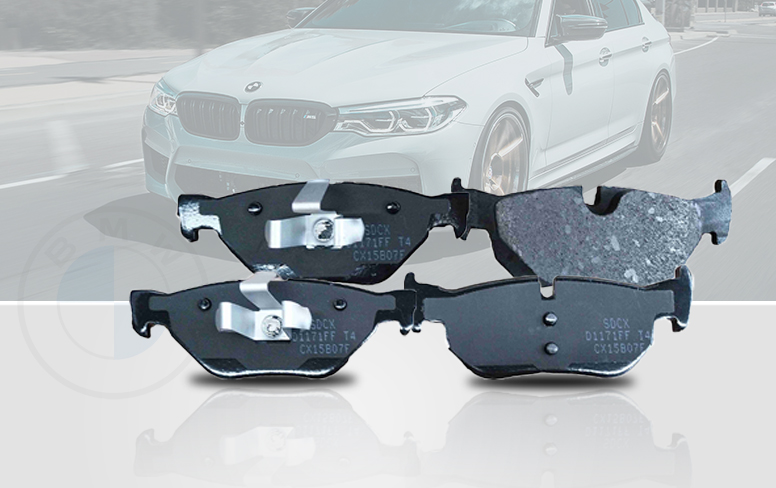
Silent Synergy: Matching BMW’s Refined Cabin Experience
BMW has long prioritized cabin refinement and driving purity, and the 3 Series is engineered to minimize noise, vibration, and harshness (NVH) while preserving tactile feedback for the driver. Unlike EVs, gasoline and hybrid 3 Series models have engine noise, but brake noise can still detract from the premium driving experience. Traditional metallic brake pads are prone to squealing or grinding, especially during low-speed braking (e.g., stop-and-go city traffic), as metal-on-metal contact creates vibrations that travel through the brake system and into the cabin. This noise would undermine the 3 Series’ balance of luxury and sportiness.
Ceramic brake pads eliminate this issue through their composition. The non-metallic materials reduce friction-induced vibrations, resulting in near-silent braking. This aligns perfectly with the 3 Series’ focus on refined performance; drivers can enjoy the engine’s soundtrack during acceleration without the distraction of brake noise during deceleration. Additionally, ceramic pads produce less dust than metallic alternatives—another benefit for the 3 Series, as brake dust buildup on its signature alloy wheels would detract from the sedan’s sleek, sporty aesthetic, a key part of its brand identity.
Efficiency Alignment: Supporting Regenerative Braking’s Role
For the BMW 3 Series—including its plug-in hybrid 330e variant—brake system efficiency is tied to both performance and, for hybrids, regenerative capability. The 330e uses regenerative braking to recapture kinetic energy during deceleration, reducing reliance on the mechanical brake system and extending brake pad life. Even gasoline 3 Series models benefit from optimized brake use, as their dynamic tuning encourages smooth, controlled braking. Unlike vehicles designed solely for utility, the 3 Series’ brake system must balance occasional high-stress use (performance driving) with daily, low-stress operation.
Ceramic brake pads are ideal for this mixed-use pattern. They exhibit superior wear resistance compared to organic pads, as their hard composition resists degradation whether exposed to occasional high-stress braking (e.g., track days for M3 owners) or daily commutes. For 3 Series owners, this translates to longer brake pad life—often doubling or tripling the lifespan of metallic pads—reducing maintenance frequency and cost. Furthermore, ceramic pads’ consistent friction characteristics ensure seamless performance across all driving scenarios, from gentle city stops to aggressive highway deceleration, preserving the 3 Series’ signature precise braking feel.
Long-Term Reliability: Meeting BMW’s Durability Standards
BMW designs the 3 Series for long-term durability and sustained performance, with its engines, transmissions, and chassis engineered to stand up to years of driving—including spirited use. The brake system must match this resilience, as frequent brake pad replacements would undermine the sedan’s value proposition of a balance between performance and practicality. Ceramic brake pads excel in this regard, thanks to their resistance to heat, corrosion, and wear—critical for a vehicle often driven in diverse conditions.
In harsh weather conditions—such as rain, snow, or salted roads—the 3 Series’ brake system is exposed to moisture and corrosive elements. Metallic pads are prone to rust and degradation, which can compromise performance over time and dull the precise braking feel. Ceramic pads, however, are non-corrosive, maintaining their structural integrity even in extreme environments. This reliability ensures that the 3 Series’ braking system remains consistent for years, aligning with BMW’s commitment to building vehicles that deliver performance and peace of mind. For owners, this means fewer trips to the service center, especially for those who use their 3 Series as both a daily driver and a weekend sports car.
Conclusion: More Than a Component—A Collaborative Design Choice
The connection between ceramic brake pads and the BMW 3 Series is not accidental; it is a result of aligned engineering goals centered on driving excellence. Ceramic pads do not merely “work” with the 3 Series—they enhance its core strengths: precision, agility, refinement, and durability. By supporting its performance capabilities, reducing noise, adapting to mixed driving patterns, and delivering long-term reliability, ceramic brake pads elevate the 3 Series’ driving experience in ways that traditional brake pads cannot.
As sports sedans continue to evolve—blending performance with efficiency and luxury—the relationship between components like brake pads and vehicle design will grow even more critical. For the BMW 3 Series, ceramic brake pads are a testament to how thoughtful component selection can preserve and enhance a legendary driving experience. They prove that stopping power is just the beginning of a deeper, more impactful partnership—one that honors the 3 Series’ heritage as the Ultimate Driving Machine.
RECENT NEWS
Sencheer Launches New Ceramic Brake Pads in August
Aug. 11, 2026
Subtle Chassis Refinement of Ceramic Brake Pads for BMW
Aug. 04, 2026
Sencheer Launches New Ceramic Brake Pads in July
Jul. 20, 2026
Custom Service
For the past 15 years, Sencheer is supplying the global market with custom brake pads using OE technology. Our customization range is wide and free, which covers logo, label, brand box, carton design, spraying code etc.
Contact Number
+86 153 7870 3202
Navigation
+86 153 7870 3202
Songjia Town Development Zone, Lingcheng District, Dezhou City, Shandong, China